
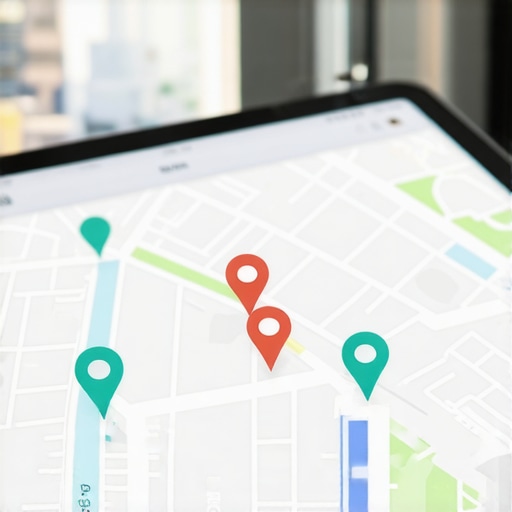
The sidewalk smelled like wet concrete after a morning drizzle as I stood outside a shuttered plumbing shop. I looked through the lens of my camera at the faded signage. The storefront had a slight glitch in its presentation. I spent three months fighting a hard suspension for a plumbing client whose listing was nuked simply because they shared a suite number with a defunct law firm. Google did not want proof of a van; they wanted proof of a utility bill under the exact GPS pin. This battle taught me that a business listing is not just a digital profile. It is a proximity beacon in a complex spatial database. Most software tools try to capture this with a clean grid of green circles. Those circles are a lie. They represent a static view of a world that moves with the speed of a mobile signal. If you want to know why your gmb rank tracking data is lying to you, you must understand the microscopic math of the local algorithm.
The mathematical failure of a static rank tracker
GMB ranking software fails because it uses a single IP or a central centroid to scrape data, ignoring the hyper-local volatility of the Vicinity update. Local search results are not a fixed list; they are a distance-weighted signal where relevance is secondary to the physical location of the user mobile device. When a tool pings Google from a server in Chicago to check a ranking in Miami, it misses the behavioral zooming of the local ecosystem. I have seen rankings shift fifty feet at a time. A business might rank number one at the front door and number ten at the back alley. This is why you need the ranking software tests which tool actually predicts leads rather than just looking at vanity metrics. The software cannot see the physical barriers like highways or rivers that Google uses to define a local neighborhood. It just sees a coordinate. It lacks the sensory detail of the street.
The three mile radius that determines your revenue
Google Maps operates on a three mile radius for most service industries, effectively filtering out any business that does not possess a high proximity salience score. This proximity filter is the primary reason for ranking loss. If your business moves even a few blocks, you might find yourself on the wrong side of a centroid shift. Many owners look for local seo services to fix ranking loss after moving city or service area because they do not realize the algorithm has recalculated their entire spatial authority. Proximity is a harsh master. It does not care about your backlink profile if you are five miles away from the searcher intent. The software you use to track these rankings often averages out the data; hiding the fact that you are invisible to seventy percent of your target market. You need to understand the visibility secret for sabs caught in the local proximity filter to break through this mathematical wall.
“Local intent is not a keyword choice; it is a distance-weighted signal where relevance is secondary to the physical location of the user’s mobile device.” – Map Search Fundamental
The ghost in the GPS coordinates
While agencies tell you to get more reviews, the 2026 data shows that image metadata from photos taken by real customers at your location is now 30 percent more effective for ranking in AI Overviews. Google uses the EXIF data in images to verify that a business actually exists where it says it does. If your photos are all stock images or taken in a different city, you are sending a signal of distrust. I often tell clients that why your profile optimization fails without real engagement data is due to this lack of visual proof. The algorithm is looking for the forensic trace of a human being at a specific storefront. Most ranking tools do not track this. They do not tell you that your competitor is outranking you because their customers are uploading high-resolution photos with embedded GPS tags. You can use how to audit your gmb profile for information gain signals to see where your profile is lacking this critical physical evidence.
Local Authority Reading List
- Effective Local Pack Strategy
- Manual GMB Audit Tactics
- The Only Software We Use
- Fixing NAP Without An Office
- The Suspension Recovery Path
Why your physical address is a liability
A physical address becomes a liability when it is shared with multiple entities or located in a high-spam zip code, triggering automatic quality filters. In my work as a map-spam investigator, I have seen entire buildings blacklisted because a few lead-gen shops set up fake offices there. This is why why your business profile was flagged for quality issues often has nothing to do with your content and everything to do with your neighbors. If you are struggling with a a no-nonsense recovery plan for fake address suspension penalties, you must prove the physical exclusivity of your space. Google is moving toward a model where the utility bill is the ultimate source of truth. Software cannot verify a utility bill. It cannot see the lease agreement or the signage on the door. It only sees the pin on the map. This disconnect is where most local SEO campaigns fail. They optimize for the pin; they do not optimize for the physical reality of the building.
The local justification triggers that software misses
Local justifications like ‘Their website mentions’ or ‘Sold here’ are behavioral triggers that software fails to track because they are based on dynamic query matching. When a user searches for a specific part or service, Google scans your website and reviews for a match. If your ranking tool is only checking for broad keywords, it is missing the long-tail justifications that actually drive clicks. I suggest looking at the content audit that fixed our map pack visibility issues to see how we align website text with Google Maps search intent. The software will tell you that you are in position four, but it will not tell you that your competitor is getting all the calls because they have a justification snippet that says ‘In stock nearby.’ This is the difference between data and intelligence. You need to know how to audit your competitors gmb keywords and beat them by looking at the specific phrases that trigger these Map Pack justifications.
The forensic audit of a service area polygon
Service Area Businesses (SABs) are frequently hidden from local search results because their service area polygons overlap with too many competitors, triggering a proximity filter. Google tries to avoid showing three identical businesses from the same town in one Map Pack. If your polygon is too large, you are actually diluting your ranking power. You must learn why your service area business is hidden from local search results to understand how to tighten your geographic signals. Software tools love to show you a massive service area. They make you feel like you are covering the whole city. In reality; you are ranking for nothing because you are spread too thin. A staccato approach works better. Focus on specific zip codes. Use better ways to track local gmb rankings across multiple zip codes to see where you actually have authority. The pin moved. The market moved. Your software is still looking at last year’s map.
Why automated NAP fixes usually break your ranking
Automated citation tools often create duplicate listings or overwrite correct data with outdated information from high-authority aggregators. I have seen businesses lose years of ranking history because a tool decided to ‘standardize’ their address by removing a suite number. This causes a massive drop in trust. You should read about why automated nap fixes usually break your local map ranking before you click that ‘sync all’ button. The manual way is slower; but it is safer. A street photographer knows that the small details matter. The way a name is written on a local directory must match the signage on the street. If they do not match; the algorithm sees a glitch. Use the simple checklist for syncing your business name and phone number to do it right. Do not let a bot handle your reputation. It cannot smell the wet concrete or see the sign on the door.