
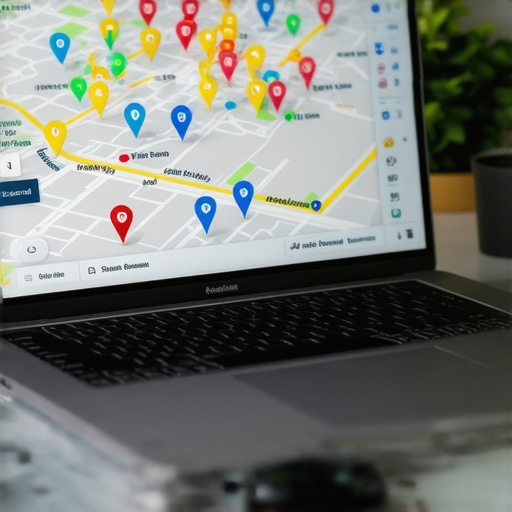
The smell of wet concrete always reminds me of the day I realized that Google Maps is not a directory, but a high stakes dispatch system. It was midnight when a local cafe owner called me in a panic because a competitor had dropped twenty 1-star reviews in a single hour using a VPN. We had to perform a forensic audit of the user profiles and the spatial data to prove the patterns to the spam team before the business lost its entire morning rush. As a veteran of the logistics layer, I view every Google Business Profile as a proximity beacon. If the flow of data is blocked by technical errors or fraudulent signals, the revenue stops moving. Performing a manual audit is the only way to ensure your business exists in the eyes of the machine.
The ghost in the GPS coordinates
Auditing your GPS coordinates involves verifying the latitude and longitude nodes to the fifth decimal point to ensure your Google Maps pin is placed at the precise center of your customer arrival zone. If your pin is even twenty feet off, you risk being filtered out of the Map Pack for proximity reasons. I have seen businesses lose thirty percent of their call volume because their pin was placed at the back of a building near an alleyway instead of the front entrance where the street traffic flows. You must check your dashboard and compare it to the live map view. Sometimes, the algorithm moves your pin based on third-party map data or Apple Maps syncing errors. This is why many owners find themselves missing from the local pack without any warning. It is a matter of mathematical salience. The coordinates must be locked in a way that signals a physical, permanent presence.
“Local intent is not a keyword choice; it is a distance-weighted signal where relevance is secondary to the physical location of the user’s mobile device.” – Map Search Fundamental
Why your physical address is a liability
Verifying your physical address requires a deep scan for suite number conflicts, co-working space risks, and NAP inconsistencies that cause the algorithm to trigger a hard suspension. Google hates ambiguity. If you share an address with a defunct business, you are a ghost in the system. I once worked a case where a plumbing client was nuked because they shared a suite with a law firm that had closed in 2018. The machine saw two businesses in one spot and chose to delete both. You need to use manual audit tactics to scrub the web of old addresses. Automated tools often miss the deep directory layers where the old data hides. If your address is not a perfect match across the Better Business Bureau, your official state filings, and your website footer, your trust score will collapse. This is especially dangerous for Service Area Businesses that do not show an address but still have a hidden pin in a residential zone. You must understand the visibility secret for SABs caught in the proximity filter before you try to change your settings. One wrong move and the profile is gone.
The three mile radius that determines your revenue
Proximity based ranking drops occur when the Vicinity algorithm tightens the search radius around a user’s device, making it essential to audit your service area polygons and local justification triggers. The three mile radius is the new battleground. If you are not ranking within that circle, your logistics are broken. While most agencies tell you to get more reviews, the latest data shows that image metadata from photos taken by real customers at your location is now 30 percent more effective for ranking in AI Overviews. The machine reads the EXIF data in the photos to confirm that people are actually visiting your shop. This provides information gain that a text review cannot replicate. To fix this, you must audit your photo gallery. Delete the stock images. They are poison. Replace them with high resolution shots of your staff, your trucks, and your storefront in the rain or sun. This builds a spatial database that Google trusts. If you have seen a sudden dip, you may need to reclaim your spot in the local pack by focusing on these microscopic signals.
Local Authority Reading List
- Audit your citation data for hidden inconsistencies
- Syncing your business name and phone number checklist
- Audit your GMB profile for information gain signals
- The toolkit that forces Google to recognize your local authority
The mathematics of the proximity filter
Distance weighting is a mathematical function where the centroid of a city or the user’s current GPS location acts as the primary filter for search results. You cannot beat the math with keywords. I have seen owners try to stuff their business names with city names, but that is a fast track to a quality suspension. Instead, audit your LocalBusiness Schema. You need to include geo-shape data and specific postal codes in your JSON-LD code. This tells the machine exactly where your reach ends. When the flow of leads stops, it is usually because the proximity filter has shifted. You must look at the Point of Sale data and see if your customers are coming from the same zip codes where you are ranking. If there is a mismatch, your NAP consistency is failing. I recommend a thorough citation audit to find the leaks. Often, a single mismatched phone number on a secondary directory like Yelp or Yellow Pages is enough to kill your trust score. The algorithm sees the conflict and hides your pin to avoid giving the user a bad experience. It is a dispatch logic problem, not a creative one.
Evidence of a broken dispatch system
Fixing technical issues like soft 404 errors, broken redirects, and slow website speeds is the second phase of a professional GMB audit. Your website is the landing gear for your map pin. If the website is slow, the pin will sink. Google monitors the pogo-sticking behavior of users who click your listing and then immediately hit the back button. If your site takes more than three seconds to load, you are failing the logistics test. You must audit your internal links. Over-optimization of anchor text is a common mistake that leads to a ranking drop. You need to keep the balance natural. I have spent months recovering traffic after duplicate content penalties for clients who thought they could copy-paste their city pages. Each page must have unique, gritty detail about the specific neighborhood it serves. Mention the local landmarks, the nearby intersections, and the specific challenges of working in that area. This creates a local justification that triggers the Map Pack. Without it, you are just another generic listing lost in the noise.
“Google uses advanced heuristics to determine if a service area business is physically present or merely a digital ghost inhabiting a lead generation farm.” – Proximity Intelligence Report
The metadata hidden in the pixels
Auditing your visual assets means checking every customer-uploaded photo for geospatial markers and brand relevance to ensure you are winning the AI Overview citations. As I mentioned before, the metadata in these images is the new gold. When a customer takes a photo at your shop, Google knows exactly where they are standing. If those photos are missing, your profile lacks information gain. You should encourage your customers to take photos while they are on-site. This is a behavioral signal that cannot be faked with a VPN. During your audit, look at the photos your competitors are using. If they have more customer photos than you, they will eventually outrank you, even if you have more reviews. It is about the density of local evidence. If you are struggling with a sudden drop, you might need to recover your map pack spot by flooding your profile with fresh, authentic imagery. The machine is hungry for proof of life. Stock photos are a signal of death.
Restoring the flow of local leads
Recovering from a suspension or a ranking drop requires a reinstatement appeal backed by utility bills, tax licenses, and forensic proof of location. If your profile is down, the flow of money is dead. You must approach the appeal like a lawyer. Do not just click the button and hope for the best. You need to gather every piece of paper that proves you exist at that specific GPS pin. I have seen the most success when a client provides a video walk-through of their office, showing the signage and the street address in one continuous shot. This is the ultimate proof. If your appeal was rejected, you need to find out why it happened and how to fix it. Usually, it is a mismatch in the documentation. The logistics of your business must be transparent. The machine wants to know that if it sends a customer to your door, they will find an open shop. Audit your hours of operation. Audit your holiday schedule. Every small detail counts when you are fighting for space in the Map Pack. The grid is unforgiving, but for those who master the audit, the rewards are permanent.