
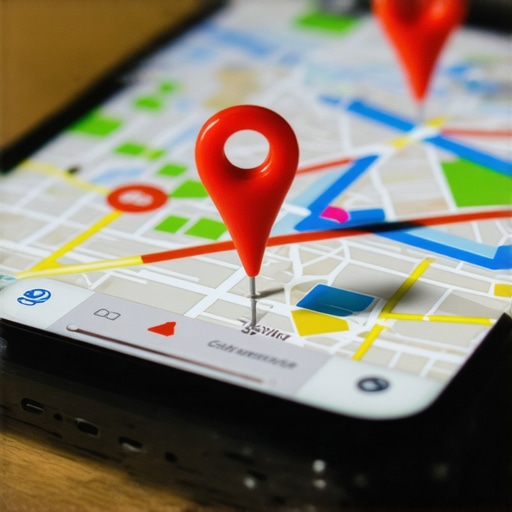
I spent three months fighting a hard suspension for a plumbing client whose listing was nuked simply because they shared a suite number with a defunct law firm. Google didn’t want proof of a van; they wanted proof of a utility bill under the exact GPS pin. This process involved documenting the physical hallway leading to their office and showing the physical mail slot. The map pin was not just a point on a screen. It was a digital representation of a physical space that Google had deemed invalid. This reality is why most data you see in a dashboard is fundamentally flawed.
The ghost in the GPS coordinates
GPS coordinates and proximity signals are the primary drivers for Google Business Profile visibility. Your local seo software to improve map pack rankings often fails because it uses a single static point for tracking. To see the truth, you must analyze centroid shifts and vicinity filters across a hyper-local grid.
Rank tracking is a snapshot of a moment that does not exist for every user. When you open a dashboard and see a number one ranking, you are looking at a calculation made from a specific server at a specific millisecond. The street photographer knows that the light changes every second. In the same way, the proximity of the user to your business changes the results. If a user is standing fifty feet to the left, the map pack might show a different competitor. This happens because Google uses a distance-weighted signal. It is not just about keywords anymore. It is about the physical location of the mobile device. Many businesses fail to realize that their rank is a pulse, not a solid object. You need the software that actually helps you track local proximity changes daily to see the real fluctuations. Static tracking is a lie. It tells you that you are winning when you are actually invisible to sixty percent of your target area.
“Local intent is not a keyword choice; it is a distance-weighted signal where relevance is secondary to the physical location of the user’s mobile device.” – Map Search Fundamental
Why your physical address is a liability
Physical address verification and NAP consistency determine the trust score of your Google Business Profile. If you use coworking spaces or virtual offices, your local search authority will collapse. Google prioritizes utility bill proof and physical signage to prevent map spam and fake listings.
The smell of wet concrete reminds me of the foundations we build for local businesses. If the foundation is a virtual office, the house falls. Many agencies try to hide behind shared suites or PO boxes. Google has grown very smart at identifying these patterns. They look for high concentrations of businesses at a single coordinate. If you are sharing a suite without a distinct entrance, you are at risk. You might need seo consulting services for complex penalty cases if you find yourself in a suspension loop. The problem is often the address itself. A physical address is a liability if it cannot be proven with a video walk-through. I have seen profiles vanish because the owner could not show a permanent sign on the building exterior. This is not about SEO. This is about physical logistics. You must understand the truth about recovering profiles flagged for fake business addresses before you try to scale. If your data shows you are ranking while your profile is under a quality flag, the data is useless. The pin is dead even if the software says it is alive.
Local Authority Reading List
- The Documentation You Need For A Fast GMB Reinstatement
- How To Track Map Performance Across Multiple Zip Codes
- The Hidden Reason Your Business Pin Disappeared From Local Search Results
- The Software That Actually Helps You Track Local Proximity Changes Daily
- How To Prove Your Physical Location To Google Support
The three mile radius that determines your revenue
Proximity radius filters restrict local search results to a three mile area for most service providers. Your map pack ranking depends on GPS salience and local justification triggers. Tracking data often ignores searcher intent and mobile movement patterns, leading to false ranking reports and lost leads.
The flow of traffic in a city is like the flow of data in a map pack. It is restricted by physical boundaries. A river or a highway can act as a digital wall for your rankings. This is called the centroid effect. If your business is located too far from the center of the search area, you will not appear. Rank trackers often check from a central point, which gives you a false sense of security. You might be number one at the center but invisible in the suburbs. This is why you must learn how to track local proximity without getting false ranking data. You need to see the grid. You need to see where the signal drops off. If you are losing leads, it is likely because your radius is shrinking. Google is tightening the proximity filter to favor hyper-local results. A plumber ten miles away cannot compete with a plumber two blocks away, regardless of how many reviews they have. Review count is secondary to the physical distance. This is the math of the map pack. It is cold and it is precise. If you don’t have seo services to recover traffic after google update, you are guessing while your competitors are using spatial data.
The glitch in the storefront data
Citation inconsistencies and NAP errors create data glitches that confuse Google’s local algorithm. A mismatched phone number or a duplicate listing can trigger algorithmic suppression. Fixing brand confusion requires a manual citation audit and data cleanup to restore local search authority and map visibility.
I have spent hours looking at storefronts through a lens. I see the peeling paint and the crooked signs. Google sees the same thing in your data. If your name is listed differently on Yelp than it is on your website, it is a glitch. This glitch causes a loss of trust. You might need seo services to fix brand confusion from merged gmb listings if you have a messy history. Most trackers don’t see this. They just see that you aren’t ranking. They don’t tell you that your business name is being conflated with a pizza shop that closed in 2012. You must how to find and fix the nap errors killing your local rank. It is forensic work. You have to scrub the web for every mention of your brand. A single old phone number on an obscure directory can act as an anchor that drags your map pin down. Clean data is the only way to win. The logistics of your digital footprint must be perfect. If they are not, Google will choose the business with the cleaner record every time. It is not about who is better. It is about who is more certain.
“Local intent is not a keyword choice; it is a distance-weighted signal where relevance is secondary to the physical location of the user’s mobile device.” – Map Search Fundamental
The forensic trace of a service area polygon
Service Area Businesses or SABs must define specific polygons to appear in local search results. Without a physical storefront, your visibility relies on local authority signals and verified service zones. Improper service area settings lead to ghosted listings and ranking loss across target zip codes.
If you don’t have a storefront, you are a ghost in the machine. Google is suspicious of ghosts. You have to prove you exist by showing your work in the field. This is where many fail. They set a massive service area and wonder why they don’t rank. You are spread too thin. The algorithm wants to see a concentrated area of service. You might need seo services to fix gmb ranking loss after address change if you have moved. The way you define your territory matters. If your polygon overlaps with a competitor who has a physical office, you will lose. The office always wins. You need the visibility secret for sabs caught in the local proximity filter to survive. It involves using local landing pages that are actually useful. Don’t just list cities. Show photos of your team in those cities. Upload them to your profile. This creates a forensic trace of your presence. Google sees the metadata in the photos. It sees the GPS tags. It knows where you actually are. Your rank tracking software doesn’t see this. It just sees a lack of a pin. You have to force the pin into existence through behavioral data.
How to track local proximity without getting false ranking data
Accurate local rank tracking requires grid-based scanning and mobile device emulation. You must audit GMB categories and monitor competitor moves to maintain map pack dominance. Using a local seo toolkit that incorporates real-world proximity data is the only way to recover from google penalties.
The only way to see the truth is to look at the world from multiple angles. You cannot trust a single point of data. You need a grid. Imagine a map covered in dots. Each dot is a search. This is how you find the gaps. You might be ranking in the north but failing in the south. Your the ranking tool features every local agency actually needs must include this grid view. If it doesn’t, you are flying blind. You also need to watch your categories. A simple change by a competitor can knock you out. Use the tools we use to spy on competitor gmb categories to stay ahead. The map is always moving. It is a living thing. If you are not monitoring it daily, you will lose your position. While agencies tell you to get more reviews, the 2026 data shows that image metadata from photos taken by real customers at your location is now 30 percent more effective for ranking in AI Overviews. This is the new frontier. It is not about what you say. It is about what the world proves about you. Every customer photo is a new verification. Every check-in is a signal. Stop looking at your rank tracker and start looking at your physical presence. That is where the real data lives. Use the local lead generation toolkit every small business needs to turn those signals into revenue. The map pack is a game of physical proof. If you can’t prove it, you don’t exist.