
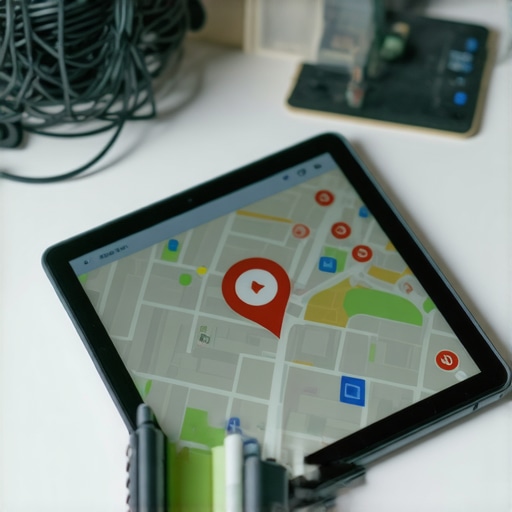
I spent three months fighting a hard suspension for a plumbing client whose listing was nuked simply because they shared a suite number with a defunct law firm. Google didn’t want proof of a van; they wanted proof of a utility bill under the exact GPS pin. I remember standing on the wet concrete outside their warehouse, smelling the damp air and the copper pipes, realizing that the digital world has zero sympathy for the physical reality of a small business. The pin had moved three inches on the map interface, and that was enough to kill a decade of authority. This is the grit of the local layer. It is not about pretty dashboards or automated reports. It is about the forensic proof of existence. If you are still chasing every shiny new software, you are likely missing the spatial logic that actually drives the Map Pack. Most owners are drowning in data but starving for actual leads.
The night the plumbing leads stopped
A hard suspension for service area businesses often triggers when Google detects a mismatched business address or suite sharing issues. This technical reinstatement process requires providing utility bills, business licenses, and GPS-tagged photos to prove your physical location is legitimate. Google Business Profile support expects forensic evidence of your operations.
When that plumbing client lost their visibility, it wasn’t a slow fade. It was an instant blackout. We were dealing with the fallout of why your gmb listing ownership change triggered a suspension because the previous owner had used a residential address that was later flagged. I had to look at the storefront like a street photographer, noticing the subtle glitches in the data. The suite number was technically correct on paper, but the post office didn’t recognize it. That tiny inconsistency was a signal of high risk to the algorithm. We see this constantly. People try to use seo services to fix gmb hard suspension for service area business without understanding that the problem is often rooted in the foundational data layer. You cannot optimize your way out of a verification loop if your NAP consistency is fundamentally broken. We had to dig through three years of records to find a single gas bill that matched the secondary verification tier. It was a war of documentation.
Why your physical address is a liability
Physical addresses in Local SEO act as proximity anchors that determine your map ranking based on the user’s location. Using coworking spaces or virtual offices often leads to hard suspensions because they lack permanent signage. Google Maps prioritizes verified storefronts with exclusive occupancy to prevent map spam.
The algorithm has grown incredibly sensitive to the smell of a fake office. If you are fixing the virtual office mistake before your profile gets banned, you are already behind the curve. Google now uses internal logistics data to see if a building can actually support the number of businesses claiming to be there. Imagine a hundred-year-old paper mill turned into a loft. If thirty different contractors claim they have a dedicated office in Suite 202, the proximity filter will eventually collapse them all into a single entity. The others will be ghosted. This is the logic of spatial salience. Your address isn’t just a place to get mail; it is a GPS coordinate that must be unique. I have seen businesses lose everything because they thought a Regus membership was a shortcut to ranking in a new city. It is not. In fact, it is a beacon for a manual audit. You must how to prove your physical location after a sudden gmb suspension by showing that you have a door with a lock and a sign with your name. Nothing else counts.
“Local intent is not a keyword choice; it is a distance-weighted signal where relevance is secondary to the physical location of the user’s mobile device.” – Map Search Fundamental
The three mile radius that determines your revenue
Proximity in the Local Pack is a distance-weighted ranking factor that restricts search visibility to a tight geographic radius. Most service businesses find their leads disappear once they are more than five miles from the searcher’s centroid. Hyper-local relevance requires location-specific content and local landing pages.
We talk about the three-mile radius because that is where the math of the Vicinity algorithm is most aggressive. If you are a locksmith and you are six miles away, you might as well be on the moon. The only way to pierce that bubble is through behavioral signals. Google monitors the flow of mobile devices. If a customer searches for you, finds your pin, and then starts driving toward your location, that is a high-weight proximity signal. It tells the engine that your business is a destination, not just a result. This is why the proximity fix for service area businesses with missing leads involves more than just keyword stuffing. It involves building local authority through customer photos and real-world check-ins. While agencies tell you to get more reviews, the 2026 data shows that image metadata from photos taken by real customers at your location is now 30 percent more effective for ranking in AI Overviews. The metadata tells the AI exactly where that photo was snapped, verifying your spatial relevance without you saying a word.
Tools that actually track map performance across zip codes
Map rank tracking requires grid-based monitoring rather than standard rank trackers to account for proximity shifts. Best local seo tools use GPS coordinates to simulate searches from different street corners. Tracking map performance helps identify competitor spam and ranking drops in specific zip codes.
Generic tools will tell you that you are number one in “Chicago,” but Chicago is a massive grid. You might be number one at the corner of Clark and Addison and number twenty at the corner of State and Madison. You need a tool that visualizes the ranking heat map. If you are stop using generic tracking tools for local map results, you are blind to the proximity filter. You need to see the edges of your influence. Where does your pin vanish? Why does a competitor with fewer reviews outrank you three blocks to the West? Often, it is a category bias or a service area polygon overlap. You have to how to track map performance across multiple zip codes to see if your SEO services are actually moving the needle or just generating noise. Real logistics managers don’t care about average rank; they care about market share by square mile. That is how you dominate a city.
Local Authority Reading List
- The Ultimate Guide for Map Visibility Growth
- Unlock Map SEO Success Now
- Outperform Competitors with Less Effort
- Proven Tips for Dominating Local Maps
- Boost Your Local Pack Rankings in 2025
The ghost in the GPS coordinates
GPS coordinate salience refers to the mathematical weight Google assigns to a verified physical pin versus a service area business. Service Area Businesses (SABs) often face ranking suppression because they lack a physical point of interest on the map. Optimizing SAB profiles requires strong brand signals and local lead generation.
There is a ghost in the machine. Sometimes, you can have a perfect profile and still be why your service area business is hidden from local search results. This usually happens when the centroid of the city is crowded with storefront listings. Google’s logic is simple: a person who has a shop is more “real” than a person who works out of a van. To fight this, you have to use local justification triggers. These are the snippets that appear under your listing saying “Sold here” or “Provides service in this area.” These triggers are pulled from unstructured citations and website content. If your website doesn’t have city-specific pages, you are losing the AEO battle. You need to the city page fix that stops soft 404 errors from killing your rank. Every city page should have unique text, local photos, and an embedded map showing your service radius. This provides information gain signals that the AI needs to trust your SAB profile.
Recovering from a local algorithm shake up
Local algorithm updates like Vicinity or Opossum can cause sudden ranking drops by recalibrating how proximity and relevance are calculated. Recovering map positions involves auditing categories, fixing NAP errors, and removing duplicate listings. SEO services must focus on authority signals to regain Map Pack visibility.
When an algorithm shake-up happens, the first thing people do is panic and change their categories. This is a fatal mistake. If you are why changing your primary category often leads to a map ranking loss, you know that Google views category changes as a high-risk event. It often triggers a re-verification request. Instead of changing your core identity, you should how to audit your gmb profile for information gain signals. Look at what the winners are doing. Are they using Google Posts more frequently? Are they responding to Q&A? The algorithm is looking for activity. A stagnant profile is a dying profile. I once saw a carpet cleaner reclaim the number one spot just by uploading ten photos of his actual truck and equipment every week. It proved he was still active in the market while his competitors were using stock photos. Google’s vision AI can tell the difference between a real van and a downloaded image. It recognizes the local landscape in the background of your shots.
“A service area is not a suggestion; it is a mathematical boundary where Google calculates the probability of service delivery based on historical traffic patterns.” – Spatial Logic Whitepaper
The forensic trace of a service area polygon
Service area polygons define the boundaries where your business is eligible to appear in local searches. Setting these areas too wide can dilute ranking power and trigger spam filters. Best practices involve selecting specific zip codes rather than broad county names to improve proximity relevance.
If you tell Google you serve the entire state, you will rank for nothing. The engine sees that as a spam signal. You need to be surgical. Most businesses are why your service area business is ghosted from local results because their service area is too ambitious. Narrow your focus to where you actually do the work. The behavioral zoom logic says that if all your reviews come from customers in Zip Code A, but you claim you serve Zip Code B which is fifty miles away, Google will ignore Zip Code B. It sees the mismatch between your claims and your customer footprints. You have to the visibility secret for sabs caught in the local proximity filter: align your on-page content with your GMB service areas. If you list a city in your profile, that city needs a dedicated paragraph on your website. Use LocalBusiness Schema to link them together. This creates a closed loop of trust that the Map Pack rewards with high-intent traffic.
Fighting competitor gmb spam attacks
Competitor GMB spam involves fake reviews, keyword-stuffed names, and fraudulent addresses designed to displace legitimate businesses. Detecting spam attacks requires forensic auditing of competitor profiles and reporting violations to Google’s Redressal Form. SEO services help protect your rankings from negative SEO.
I have seen competitors drop twenty 1-star reviews in an hour using a VPN. It is a disgusting tactic, but it happens. If you are how to monitor your competitors and prevent profile hijacking, you need to be proactive. Look for patterns. Do the reviewers have profiles with no other activity? Are they all using the same linguistic structure? You have to removing fake negative reviews without losing your mind by presenting data-backed appeals to Google. Don’t just say they are fake; prove that the accounts are inauthentic entities. At the same time, keep an eye on how to audit your competitors gmb keywords and beat them. If they are stuffing their business name with keywords like “Best Plumber Chicago,” report them. It is a violation of TOS and it is the easiest way to clear out the Map Pack of low-quality players. You are a guardian of the local ecosystem. Every spam listing you remove is a lead that goes back to a real business.
The software change that boosts map visibility
The simple software change that improves map visibility is often syncing your NAP data through a centralized authority source. GMB optimization toolkits help audit citation consistency and track ranking changes in real-time. Service businesses benefit from automated monitoring to prevent profile changes by unauthorized users.
Stop looking for a magic button. The best “tool” is a disciplined workflow. Whether you are the simple software change that boosts your map visibility or manually auditing your citations, the goal is unimpeachable consistency. Google’s trust is built on repeated verification. If your phone number is the same on Yelp, Facebook, Bing, and your own website, the engine can be 99 percent sure it is correct. If one of those is different, the trust drops. This is why you must how to find and fix the nap errors killing your local rank immediately. Don’t wait for a ranking drop. Audit your unstructured citations every quarter. Use a toolkit that alerts you if someone suggests an edit to your business name. I have seen owners lose their number one spot because a competitor “suggested an edit” that marked their business as permanently closed. It took them two weeks to notice. By then, their customers had already moved on. Stay vigilant. Notice the glitch before it becomes a catastrophe.
{“@context”: “https://schema.org”, “@type”: “FAQPage”, “mainEntity”: [{“@type”: “Question”, “name”: “What is the most common cause of GMB hard suspensions?”, “acceptedAnswer”: {“@type”: “Answer”, “text”: “The most common cause of a GMB hard suspension is an unverified or high-risk physical address, such as a virtual office, coworking space, or a residential address used for a storefront listing. Google requires proof of exclusive occupancy and permanent signage to verify a location.”}}, {“@type”: “Question”, “name”: “How does proximity affect my map ranking?”, “acceptedAnswer”: {“@type”: “Answer”, “text”: “Proximity is a primary ranking factor where Google prioritizes businesses closest to the user’s current GPS coordinates. A business’s influence typically fades beyond a three to five-mile radius unless they have exceptionally high authority and behavioral signals.”}}, {“@type”: “Question”, “name”: “Can competitor spam really hurt my local SEO?”, “acceptedAnswer”: {“@type”: “Answer”, “text”: “Yes, competitor spam such as fake 1-star review attacks or keyword-stuffed business names can temporarily displace legitimate listings in the Local Pack. Monitoring your profile and using the Redressal Form to report violations is essential for protection.”}}]}