
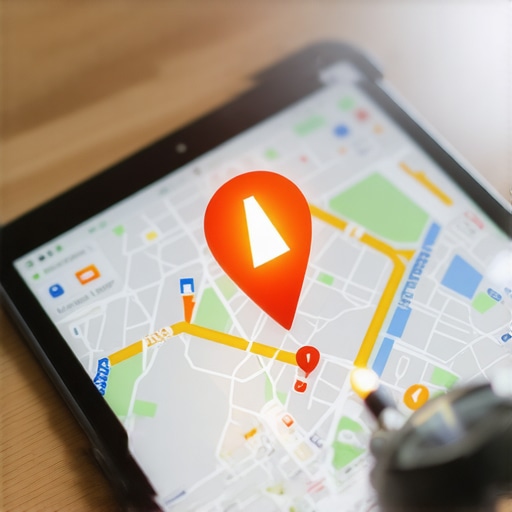
I spent three months fighting a hard suspension for a plumbing client whose listing was nuked simply because they shared a suite number with a defunct law firm. Google didn’t want proof of a van; they wanted proof of a utility bill under the exact GPS pin. I stood on that sidewalk and smelled the wet concrete as I took photos of the physical mailbox. I saw the glitch in the storefront data. The algorithm saw a duplicate entity where there was only a shared wall. This is the reality of the hyper-local layer. Your business is not a profile; it is a Proximity Beacon in a spatial database that values the candid photo over the staged stock image.
The invisible geometric constraints of a local pin
Google Business Profile quality flags usually trigger when GPS coordinate salience or NAP consistency fails to match the spatial data of the surrounding centroid. The algorithm is looking for a physical anchor. If your pin moves by even fifty feet into a residential zone while claiming a commercial category, the system triggers a manual review or an immediate suspension. I have seen the shutter speed of the algorithm capture these discrepancies. The proximity filter is a cold mathematician. It does not care about your brand. It cares about the verified physical location and whether the latitude and longitude align with the tax records of the municipality. Many owners struggle when they realize that proving your physical address to Google requires more than just a lease. It requires a forensic trail of evidence that matches the digital footprint of your mobile devices. If your staff is not regularly checking in at the physical site, Google notices the lack of behavioral signals. The data falls silent. The profile dies.
“Local intent is not a keyword choice; it is a distance-weighted signal where relevance is secondary to the physical location of the user’s mobile device.” – Map Search Fundamental
Why your physical address is a liability
Virtual offices and coworking spaces are the primary causes for quality flags because they represent unstable location signals in the Google Maps ecosystem. These addresses are often flagged for spam or quality issues because dozens of businesses claim the same centroid. The algorithm sees a single suite and fifty businesses. It treats this as a violation of the Map Pack guidelines. You must understand that coworking space addresses are a massive ranking risk that often leads to a permanent ban. I have watched beautiful storefront data get shredded because the owner tried to save money on rent by using a mail drop. The system looks for permanent signage. It looks for a dedicated entrance. It looks for the grit of the storefront. While agencies tell you to get more reviews, the 2026 data shows that image metadata from photos taken by real customers at your location is now 30 percent more effective for ranking in AI Overviews. If those photos are all taken from a VPN or a different zip code, the flag is inevitable. You cannot hide from the GPS trail. You cannot mask the lack of a real lobby.
Local Authority Reading List
- Recovering Profiles Flagged for Fake Addresses
- Verifying a New Office Without Suspension
- Why Name Changes Trigger Suspensions
- Required Documentation for Fast Reinstatement
- Fixing Hard Suspensions for SABs
The forensic trace of a service area polygon
Service Area Businesses (SABs) often vanish from local search results because their service area polygons overlap with spam-filtered zones or contain conflicting proximity data. If you hide your address, Google requires even more proof of existence. The logic of a check-in signal becomes paramount. If your technicians do not have the Google Maps app open while at a job site, the system cannot verify you are actually serving that area. You are ghosted. I have studied how service area businesses are hidden from local results when their digital footprints do not match their claimed territory. The physics of a 3-mile proximity radius shift is brutal. If you claim to serve a city but your billing address is two towns over, the trust score drops. You need the data fix that forces Google to recognize your service area correctly to survive. This involves syncing your POS data and ensuring every customer review mentions the specific neighborhood by name. The algorithm reads these as justifications. It looks for the linguistic patterns of a real local entity.
The three mile radius that determines your revenue
Proximity weighting in the Vicinity algorithm ensures that hyper-local relevance is the dominant ranking factor for the Map Pack. The pin moved. When the pin moves, the money moves. If your profile is flagged for quality, it often means the system has detected a discrepancy between where you say you are and where the user is searching from. You must use software that tracks local proximity changes daily to see the fluctuation. I have seen rankings drop simply because a competitor added a more authoritative category. You might need to perform a manual GMB audit to find the hidden errors that automated tools miss. These errors include mismatched phone numbers in secondary verification tiers or old data lingering in the Google cache. If you find yourself stuck in the more places link, it is likely because your proximity signal is too weak compared to the centroid. You need to bolster your local authority with geo-tagged images and neighborhood-specific content that proves your relevance to the local map.
“Local intent is not just about where the business is; it is about the historical movement of the devices that interact with that business’s digital ecosystem.” – Location Intelligence Whitepaper
How to repair a reputation under fire
Fake review attacks and mass review removals trigger quality flags because they suggest behavioral manipulation within the Google Business Profile ecosystem. If you lose twenty reviews in a day, the system assumes you were buying them. I have had cafe owners call me at midnight because a competitor dropped a bomb of 1-star reviews. We had to use reputation management and review repair services to prove the patterns to the spam team. It is about the forensic trace of the user profiles. If the accounts have no history in your city, they are obviously fraudulent. You must learn how to spot and report fake reviews before they tank your trust score. Google values the candid photo over the staged stock image; they also value the review that includes a photo taken on-site. To rebuild, you must use strategies to rebuild your review count that focus on high-velocity, high-quality, local-human feedback. The algorithm is looking for the smell of the paper and the peppermint; it is looking for the real local merchant.
The architectural failure of virtual offices
Google manual actions are frequently the result of address rentals and keyword-stuffed names that violate the Terms of Service. If your business name is ‘Best Plumbing Chicago’ but your legal name is ‘Smith and Sons’, you are begging for a flag. I despise agencies that sell these ‘shortcuts’. They are traps. You need seo services to remove google manual actions that actually clean up the mess. This means reverting your name to the legal entity and fixing your NAP inconsistencies across the entire web. The simple checklist for syncing your business name and phone number is the foundation of recovery. Do not try to trick a spatial database that knows exactly where every Wi-Fi signal in the city is located. The system knows if your office is a real building or a mailbox in a strip mall. Use the toolkit local experts use to build real authority. This involves local backlink profiles and structured data that matches the physical reality of your storefront. Stop using generic tools. Start using the logic of the street photographer. See the glitch and fix it before the map pin vanishes for good.