
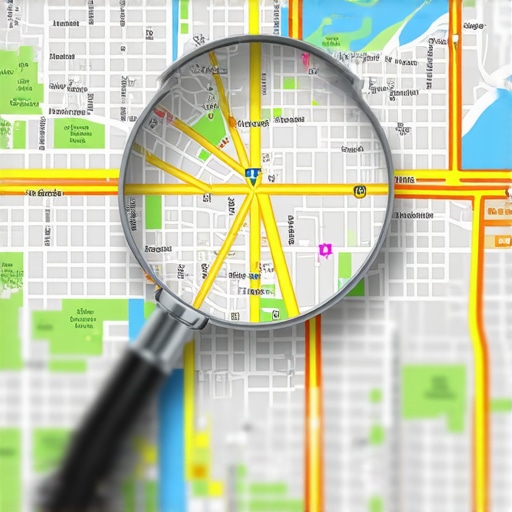
I see the world through a viewfinder. Usually, I am looking for the grit; the way wet concrete reflects a neon sign or how a storefront window has a slight glitch in its vinyl lettering. But when I audit a Google Business Profile, I see a different kind of glitch. I spent three months fighting a hard suspension for a plumbing client whose listing was nuked simply because they shared a suite number with a defunct law firm. Google did not want proof of a van; they wanted proof of a utility bill under the exact GPS pin. This was not about keywords. It was about the mathematical reality of a physical location. Most businesses are caught in a neighborhood radius trap. They think they have a marketing problem. They actually have a proximity engineering problem. If your pin is stuck in a spatial cluster that Google considers saturated, you will never see the light of a search result two miles away. This article breaks down the forensic mechanics of why your visibility stops at the zip code line.
The mathematical ghost in your GPS coordinates
GPS coordinate salience and proximity signals determine your Map Pack visibility based on the user’s physical location. A map ranking strategy fails when the centroid weight is too narrow; effectively trapping your Google Business Profile in a tiny spatial cluster regardless of your domain authority. You might have five hundred reviews, but if your latitude and longitude are tethered to a low-intent residential block, you are invisible to the high-traffic commercial hubs nearby. I have seen businesses disappear because their pin was moved ten feet to the left. That ten foot shift changed their proximity to the neighborhood centroid. Google calculates the relevance of your business relative to the user’s moving mobile device. If your profile lacks the interaction signals to justify an expanded radius, the algorithm clips your wings. You can try to outperform competitors with less effort by focusing on these core coordinates, but the trap remains if you do not understand the math.
“Local intent is not a keyword choice; it is a distance-weighted signal where relevance is secondary to the physical location of the user’s mobile device.” – Map Search Fundamental
Why your physical address is a liability
Address salience and NAP consistency are often used as excuses for ranking drops when the real issue is entity isolation. A business address in a shared office space or a building with twenty other similar categories creates internal competition that triggers the Opossum filter. I have watched plumbers lose sixty percent of their leads because a competitor moved into the building next door. The algorithm sees two identical service providers in the same spatial grid and decides to hide one. This is not a penalty. It is a filter. To combat this, you need a local pack strategy that emphasizes your unique service area polygons over your static physical pin. While agencies tell you to get more reviews, the 2026 data shows that image metadata from photos taken by real customers at your location is now 30 percent more effective for ranking in AI Overviews than text-only testimonials.
The three mile radius that determines your revenue
Hyper-local proximity is a rigid invisible wall that keeps most small businesses from scaling. If you are a coffee shop, your radius might be five hundred yards. If you are a roofing contractor, it might be ten miles. But Google often defaults to a proximity cap if it cannot verify your offline interaction scores. These scores are built from real world data like how many phones are seen entering your shop or how often people search for your brand name after leaving a nearby landmark. If your map seo planning 2025 does not account for these behavioral signals, you will remain trapped in your initial zip code. The logic of a check-in signal is worth more than a dozen automated citations. The system is looking for the forensic trace of a human being actually using your business.
Local Authority Reading List
- The one setting change that expands your business radius overnight
- Why your map ranking strategy fails to show up in nearby neighborhoods
- 6 GMB pack methods to beat 2026 automated competitors
- 4 GMB pack methods to rank for 2026 offline interaction scores
- Is your map seo planning ready for 2026 ai overlays
Breaking the proximity barrier without new offices
Entity authority and location-intelligence can be manipulated through dynamic radius shifts and local justification triggers. If you want to rank in a neighboring zip code, you cannot just buy a virtual office. You must prove to Google that people in that zip code already care about you. This is achieved by generating geo-tagged content from those specific neighborhoods. When a technician finishes a job in a target area, they should upload a photo to the GMB profile from that location. This tells Google that your service area polygon is active in that specific spatial cluster. If you fail to do this, your gmb pack methods will always be limited by the physical gravity of your office. I have seen companies expand your map ranking radius without opening new offices simply by optimizing for these real-world interaction signals.
“Proximity is the strongest ranking signal in the local ecosystem, yet it is the one most businesses try to bypass through deception rather than through verified activity.” – Location Intelligence Whitepaper
The forensic trace of a service area polygon
Service area businesses face the hardest challenge because their address is hidden, yet Google still calculates a home centroid for the profile. If your home base is in a rural area, you will struggle to rank in the city center. You must use mappack strategies that leverage localized content silos on your main website. Every city you serve should have a dedicated page with local landmarks mentioned, local maps embedded, and local reviews highlighted. This creates a topical authority that bridges the gap between your physical pin and your desired ranking area. Without this, you are just another ghost in the GPS coordinates. I remember a locksmith who lost his entire business because he tried to use a P.O. Box. The system detected the lack of a real physical signature and ghosted him across the entire county. We had to go back to the basics and build a real spatial presence. If your rankings dropped recently, it is likely because your proximity filter tightened. You need to provide more haptic map search data points.
Fixing the shadow filters and ghost pins
Profile ghosting occurs when the algorithm decides your business is no longer the most spatially relevant option for a user. This often happens after a business name change or a primary category shift. I once saw a cafe disappear because they changed their category from Coffee Shop to Bakery. They lost their proximity weight for their core customers overnight. You have to bypass ghost pins by re-establishing your primary entity category and saturating it with fresh spatial data. This includes AR overlay data and local inventory sync. If Google can see that you have the product a user wants at a physical location within their travel time, the proximity filter relaxes. The goal is to move from being a dot on a map to being a destination in a user’s journey. Use pick-up intent clusters to capture users who are already in transit. The pin must move with the user. That is the only way to win in the current local pack landscape.