
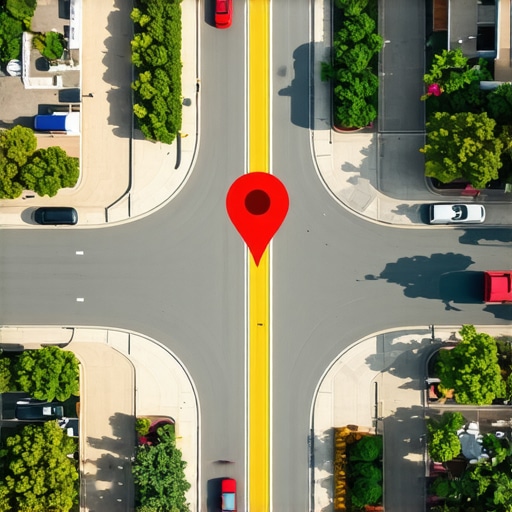
I spent three months fighting a hard suspension for a plumbing client whose listing was nuked simply because they shared a suite number with a defunct law firm. Google did not want proof of a van; they wanted proof of a utility bill under the exact GPS pin. This is the reality of the modern Map Pack. It is a spatial database that values physical evidence over digital whispers. You are not just managing a profile. You are managing a proximity beacon. If that beacon flickers because of a mismatched suite number or a ghost of a previous tenant, your revenue vanishes. Most agencies offer cheap fixes, but the real work happens in the microscopic layers of location intelligence.
The ghost in the GPS coordinates
Geo-specific trust signals are the mathematical weights Google uses to determine if your business deserves to occupy a specific coordinate. These signals include high-resolution image metadata, customer device location history during check-ins, and the alignment of your physical footprint with local authoritative databases. While many business owners worry about keyword density, the algorithm cares more about whether a mobile device actually stopped at your front door. If you want to understand why your business pin keeps dropping and how to fix it, you must look at the data points that prove your physical existence. One of the most common reasons for a ranking drop is the presence of legacy data from a business that moved out five years ago. Google sees the overlap and loses trust in your location validity.
The mathematical weight of a local review is not just about the text. It includes the GPS history of the person leaving the review. If the reviewer has never been within five miles of your office, their 5-star rating carries significantly less weight than a local resident who visits the neighborhood daily. This is why why automated review software often kills your local map rank. The lack of organic movement data attached to those reviews signals a fake interaction. You need real people in your zip code to engage with your profile while their location services are active. This creates a proximity trail that forces the algorithm to recognize your relevance in that specific block.
“Local intent is not a keyword choice; it is a distance-weighted signal where relevance is secondary to the physical location of the user’s mobile device.” – Map Search Fundamental
Why your physical address is a liability
Your business address can become a liability if it is tied to a high-competition centroid or if it lacks distinct spatial markers. Google uses centroid theory to cluster similar businesses, often suppressing those that appear too close together in favor of the most established entity. If you are a new law firm in a building with ten others, your pin is fighting an uphill battle against the primary occupant. This is where the specific map tactics helping solo attorneys outrank massive law firms become vital. You must create unique trust signals that differentiate your suite from the rest of the building. This involves using the schema secret for attorneys that competitors are completely ignoring, which allows you to define your exact office coordinates within a larger structure.
Misaligned data is the fastest way to get ghosted. I often see businesses using services to fix mismatched business address and phone number issues, but they forget the legacy footprint. If your phone number once belonged to a pizzeria, and now it belongs to your HVAC company, Google might still associate that number with the previous category. This creates a conflict in the proximity layer. You need a clean audit. You can find how to audit your google maps citations without using broken automated tools to ensure your NAP (Name, Address, Phone) is pristine across the entire web. A single old directory listing with the wrong address can act as an anchor, pulling your ranking down every time the algorithm does a verification sweep.
The three mile radius that determines your revenue
The three mile radius is the standard visibility limit for most service area businesses before proximity decay sets in. To push past this barrier, you must utilize hyper-local content and engagement signals that prove your activity in neighboring districts. Google looks at the geographic distribution of your customers. If 90 percent of your service calls are in one zip code, you will rarely rank in the next town over. To fix this, you need the visibility tactic that forces google to rank your profile in nearby towns. This involves more than just a city name on a page. It requires uploading photos of jobs completed in those specific areas, which carries the GPS metadata Google uses to verify your service reach.
Many owners ask how to expand your map ranking radius without opening new offices. The answer lies in your behavioral signals. When users in a neighboring town search for your service and click your profile, it tells Google that your relevance extends beyond your physical office. This is a behavioral zoom. You can trigger this by using the local link tactic that actually pulls nearby traffic to your front door. These are not generic backlinks. They are links from local chambers of commerce, neighborhood blogs, and local suppliers that exist within the target radius. Google treats these as spatial endorsements.
Local Authority Reading List
- Mastering Mappack Strategies for 2025
- How to Push Your Pin Beyond Two Blocks
- The NAP Audit Checklist
- GMB Profile Reinstatement Experts
Technical cleanup of legacy black hat footprints
Cleaning up legacy black hat footprints requires a deep forensic audit of your historical citation data and backlink profile. Many businesses are unknowingly suffering from seo services to clean legacy black hat local seo footprints that were implemented years ago by previous agencies. These include keyword-stuffed business names and virtual office locations that now trigger automated suspensions. If your profile was previously managed by an agency that used spam tactics, you need seo services to clean up ai generated spam content penalties. Google is now using AI to detect AI, and if your business descriptions or review responses sound like a bot, you will lose the trust of the local algorithm.
The proximity layer is sensitive to sudden changes. If you suddenly change your business name to include ten keywords, expect a suspension. You should understand why your recent business name change caused a sudden map suspension before making any edits. Instead of manipulation, focus on the best toolkit to improve local search rankings, which includes verified local news mentions and real-time social signals. If you have been hit by an update, look into seo services to recover traffic after google update specifically tailored for local businesses. The recovery process for a map ranking is different from a traditional organic site recovery; it requires rebuilding the spatial trust of the physical address.
The microscopic math of review sentiment
Review sentiment analysis by Google now includes entity recognition and proximity verification of the reviewer. It is no longer about the number of stars. The algorithm scans for specific service keywords and matches them to your GMB categories. If a customer mentions a specific service like water heater repair, and you have that as a sub-category, the relevance signal is amplified. To find the right categories, you can use tools to find gmb categories and keywords that high-ranking competitors are using. However, if the review comes from someone who is three states away, the sentiment weight is discounted. This is why why your google review requests are getting ignored and how to fix it is a technical problem as much as a social one.
Engagement signals are the new currency. A profile that gets calls, direction requests, and website clicks every day is seen as a healthy, trusted entity. If you are stuck in the more places link, you need to learn how to pull your business out of the more places link with a citation audit. This process identifies the discrepancies that prevent Google from putting you in the top three. Often, it is a low engagement rate. You can use a how to get more calls from google business profile toolkit to optimize your call to action buttons and post updates. These micro-interactions tell the algorithm that people in your neighborhood value your business. The pin moved because the community moved it.
“Local businesses that maintain higher engagement-to-impression ratios consistently outrank businesses with larger review counts but lower interaction levels.” – Local Search Intelligence Report
Forensic verification of local service area polygons
Service area polygons are the digital borders you draw in Google Business Profile to define where your workers actually travel. If these polygons are too large, you dilute your proximity signal. A plumber claiming a 100-mile radius is less trustworthy than one claiming a 10-mile radius. You must learn how incorrect service area settings can ghost your business from local results. Google verifies these areas by looking at the location history of your service vans if they are running Google-linked apps. The forensic trace of your business activity must match the area you claim. This is the service area secret that helps plumbers own the neighborhood map. Tightening your service area can actually increase your visibility in the core zip codes because it concentrates your relevance signal.
If you find that your map pin vanished after you updated your service area, it is likely because the new area triggered a verification check that you failed. Google is suspicious of broad claims. You need to provide proof of your presence in those areas through the content move that forces google to map your service area correctly. This includes service-specific landing pages with local schema. If you are managing multiple locations, consider a gmb ranking toolkit buy to monitor each pin individually. Do not rely on automated reports that aggregate data, as they often hide the local drops that occur on a block-by-block basis. You need granular data to see where the signal is failing.