
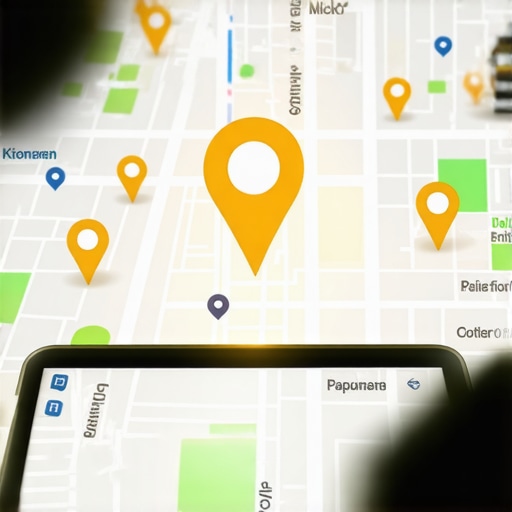
I remember the smell of wet concrete on the morning the plumbing client called. He was frantic. His listing had been nuked in a hard suspension because he shared a suite number with a defunct law firm. Google did not care about his fleet of vans or his decades of service. They wanted a utility bill under the exact GPS pin. This is the reality of the map pack; it is a spatial database where math beats marketing every single time. I spent three months fighting that suspension, proving that his business existed in the physical world. It was a war of documentation and coordinate salience. Most agencies would have just told him to buy a new domain. I knew the problem was not his website; it was a proximity collision in the local database.
The ghost in the GPS coordinates
GPS coordinate salience and centroid proximity determine whether your business appears in the Local Map Pack or remains invisible to high-value customers. Google uses Wi-Fi triangulation and mobile device history to verify if a business actually operates at its claimed physical address. Improving map pack rankings requires aligning LAT/LONG data with local justifications. While most people look at keywords, I look at the glitch in the data. When a pin moves even twenty feet, the proximity radius shifts. This shift can exclude you from a neighborhood search entirely. Using software to monitor map pack positions is the only way to see these microscopic fluctuations before they kill your lead flow. The algorithm is not looking for the best plumber; it is looking for the closest verified entity with the highest density of local signals. If your coordinates are even slightly off, you are ghosting your own customers.
Why your physical address is a liability
Google Business Profile suspensions often stem from address proximity conflicts and shared suite numbers that trigger quality filters. A service area business (SAB) must prove its physical presence through secondary verification tiers and utility bill matching to avoid hard suspensions. Fixing these issues requires local seo services that specialize in GMB profile reinstatement. I have seen listings disappear because a competitor moved into the same building. Google sees two businesses in the same category at the same address and assumes one is a duplicate. This is why you need to successfully appeal a GMB hard suspension by providing forensic proof of operation. It is not just about a photo of your office. It is about the digital footprint you leave in the city. Every check-in signal and every customer photo taken at that location adds weight to your pin. Without that weight, your address is just a line of text that Google can delete at any moment.
“Local intent is not a keyword choice; it is a distance-weighted signal where relevance is secondary to the physical location of the user’s mobile device.” – Map Search Fundamental
The three mile radius that determines your revenue
Local search proximity is restricted to a three mile radius for most high-competition service categories. To expand this ranking radius, you must optimize for neighborhood-specific content and hyper-local citation consistency across high-authority directories. Dominating the Map Pack involves behavioral zooming into ZIP code data. Most owners think they rank in the whole city. They do not. They rank in a small circle around their front door. If you want to grow, you have to understand why your map seo planning fails to account for these shifts. You can’t just wish your way into a neighboring town. You need to build a web of local relevance that stretches your authority. This involves getting reviews from people who live in those target areas. Google tracks the GPS history of the reviewer. If all your reviews come from people twenty miles away, Google knows you are not the local authority for the immediate neighborhood.
Category insights that reveal competitor weakness
Primary and secondary GMB categories act as relevance anchors that determine which search queries trigger your business profile. Analyzing competitor category choices allows you to identify keyword-stuffing penalties and service area overlaps that can be exploited for ranking growth. Most businesses pick the obvious primary category and stop. They miss the secondary triggers that drive twenty percent of the traffic. By using tools to spy on competitor GMB categories, you can find the gaps. Maybe your competitor is listed as a general contractor but is getting all their leads for roofing. If you optimize your secondary categories for roofing while keeping your primary category focused, you can outmaneuver them without triggering a suspension. It is a game of chess played with metadata. If you change your category too often, you trigger a manual review. If you don’t change it enough, you stagnate. You need to find the balance that keeps the algorithm happy while capturing the widest possible net of search intent.
Local Authority Reading List
- Effective Local Pack Strategy for 2025
- The Exact Tools for Map Pack Audits
- Auditing Reputation Without Expensive Software
- Why Over-Optimization Kills Map Visibility
- The Neighborhood Strategy for Plumbers
Technical signals that trigger local justifications
Local search justifications are short snippets of text that appear in the Map Pack to prove a business matches a specific search query. These snippets are pulled from Google reviews, website content, and GMB posts using Natural Language Processing. Winning these justifications increases your click-through rate significantly. I have seen businesses with fewer reviews outrank giants simply because they had a justification that said their website mentions the specific service. This is why the one content change that improved our map clicks is so vital. It is not about writing for humans anymore; it is about writing for the parser that generates those snippets. You need to mention your services and your city in a way that feels natural but remains highly scannable for the AI. If your website does not explicitly link your services to your location, Google will not give you the justification. You are leaving money on the table every time a customer sees your competitor’s listing highlighted with the exact phrase they searched for.
Why automated NAP tools fail
NAP consistency is a foundational ranking signal, but automated citation tools often create duplicate profiles and mismatched data points that hurt local authority. Manual citation cleanup is required to fix historic spam campaigns and incorrect phone numbers across tier-one directories. I despise automated fixes. They are like putting a band-aid on a broken leg. You need to understand why automated NAP fixes usually break your ranking. They often overwrite correct data with older, incorrect info from a forgotten database. I have seen clients lose years of ranking power because an automated tool decided their suite number was formatted wrong. You need to get in the dirt and fix these things by hand. Contact the directories. Delete the duplicates. It is tedious work, but it is the only way to build a foundation that won’t crumble when Google does an update. A clean digital footprint is worth more than a thousand low-quality backlinks.
“The proximity of the business to the searcher is the single most important factor for local search ranking, regardless of review count or website authority.” – Vicinity Research Paper
Logistics of a service area polygon
Service area businesses must define their geographical boundaries using polygons or ZIP codes within the Google Business Profile dashboard. Map visibility is highest when the service area is tightly defined rather than covering an entire metropolitan region. If you try to claim too much territory, you dilute your authority. I have managed fifty pins for a national brand and the ones that always performed best were the ones with the smallest, most focused service areas. You have to learn how to plan your neighborhood strategy for higher rankings. If you set your area to a hundred-mile radius, Google thinks you are a national brand and removes you from local searches. You want to be the local hero. Define your area by the streets your vans actually drive. This creates a density of relevance that the algorithm respects. When your service area matches the GPS patterns of your workers, the trust score of your profile sky rockets.
The math of local review sentiment
Review sentiment analysis and high-resolution customer photos provide semantic evidence of business legitimacy to AI Overviews. Businesses that respond to negative reviews with factual, non-defensive language maintain higher trust scores and proximity rankings. The data shows that image metadata is becoming a dominant factor. When a customer takes a photo at your shop, that photo contains GPS tags. Google uses those tags to verify you are where you say you are. This is why the image tactic that increases click-through rate is more about verification than aesthetics. Encourage your customers to take photos. Those photos are the digital receipts of your existence. In a world of AI-generated spam, a grainy photo of a real person at a real desk is the ultimate ranking signal. It proves you aren’t just an address rental or a ghost in the machine.
Cleaning the citation trail
Citation audits reveal hidden inconsistencies in business names and tracking numbers that cause ranking drops after moving cities or changing owners. Fixing NAP inconsistencies requires a forensic approach to local SEO services. You have to be a detective. You have to find the old Yelp profile from 2012 that still has your old phone number. That one incorrect listing can act as a poison pill for your entire map presence. I always tell people to audit citation data for hidden inconsistencies before they start any new SEO work. If the foundation is cracked, the house will fall. It doesn’t matter how many new reviews you get if Google’s core database is confused about whether you are at 123 Main St or 123 Main Ave. These tiny details are the difference between a phone that rings all day and a business that is invisible. Take the time to clean the trail. It is the most profitable work you will ever do.